![]() |
| Los Eslim Reloaded in la Calle Gerona, La Alquitara Festival de Blues Bejar Photo @Ruben Martin |
Tales from the Mediterranean. Stories Behind the Images. Award winning Travel Writer Troy Nahumko's writing platform.
About Me
- Troy
- Troy Nahumko is an award-winning author based in Caceres, Spain. His recent work focuses on travels around the Mediterranean, from Tangier to Istanbul. As a writer and photographer he has contributed to newspapers and media such as Lonely Planet, The Boston Review, The Globe and Mail, The Sydney Morning Herald, The Toronto Star, Counterpunch,The Irish World, The Straits Times, The Calgary Herald, Khaleej Times, DW-World, Rabble and El Pais. He also writes a bi-weekly op-ed column 'Camino a Ítaca' for the Spanish newspaper HOY. His book, Stories Left in Stone, Trails and Traces in Cáceres, Spain is published by the University of Alberta Press.As an ESL materials writer he has worked with publishers such as Macmillan and CUP.
Writing Profile
- Links to Published Pieces
- The Boston Review
- The Globe and Mail
- Perceptive Travel
- Roads and Kingdoms
- Brave New Traveler
- The Toronto Star
- The Straits Times (Singapore)
- Khaleej Times, Dubai
- Traveler's Notebook
- Matador Network
- Calgary Herald
- Salon
- DW-World/Qantara
- Go Nomad
- El Pais (English)
- Go World Travel
- The Irish World
- Trazzler
- International Business Times
- HOY (Spanish)
- Teaching Village
- Verge Travel Magazine
- BootsnAll
- Rabble.ca
- SUR in English
- Counterpunch
- The Sydney Morning Herald
- ZNetwork
Saturday, July 26, 2025
A Harmony of Difference
In a world that often shouts about what sets us apart, there’s something quietly radical about embracing what brings us together. In this week's Camino a Ítaca a counterdance against the demagogues threatening to deport an imaginary eight million immigrants.
Tuesday, July 15, 2025
Poolside Austerity
![]() |
| Piscina natural (wild swimming hole) Villasbuenas de Gata |
On Benches, Boulevards, and the Beauty of Belonging
One of the things I’ve always admired about life in Spain is how public public space truly is. A square is not something to pass through—it’s something to dwell in. A bench belongs to whoever needs a rest. A park, a pool, a plaza: these are shared extensions of daily life, not fenced-off amenities with wristbands and surveillance.
And most striking of all? There’s no shame in simply being there. No sideways glances. No sense that you’re “loitering.” That concept—so ingrained in Anglo-Saxon cultures—has never taken root here. Until now, maybe.
In my latest Camino a Ítica pieces, I reflect on the creeping encroachment of privatization into Spanish public life—how the very spaces that have long defined a more open, inclusive way of living are now being reshaped by the quiet return of austerity, market logic, and the ever-watchful eye of exclusivity. Read the piece in English in SUR in English or the Spanish version in the HOY.
Because once we stop noticing the velvet ropes going up around us, it might already be too late. (PDF en castellano abajo)
Saturday, March 29, 2025
The Great Unravelling
The Camino a Ítaca climbs the Statue of Liberty this week for a look around to see what is left of something precious that we once took for granted. It's not gone...yet. But it is clear that what we once thought immutable is nowhere near permanent. This week in both English and Spanish. Click over to read the unravelling in Sur in English here or a slightly shorter version (word count issues) in HOY in Spanish here. (PDF en castellano abajo)
Saturday, December 21, 2024
The Ice Cream Man
This ain't John Brim's seminal Ice Cream Man and perhaps little more of David Lee Roth's take on it. In this week's Camino a Ítaca Christmas and what it means for the oldest city in the world. Will it turn into a Turkish colony? Will the Israelis make a huge land grab or simply annex it? Will it become Kabul-West? Will the Kurds finally get a 'promised land'? Will the Ice Cream man still be around? Click over to read the Spanish version in the HOY or the English. If not, the original unedited piece below. (PDF en castellano abajo)
It took place just down a covered
corridor that was sporadically lit by what seemed like bullet holes in the tin
roof. In my memory, it was the scene that most represents Christmas. By that I
don’t mean the conical medieval torture device by day and notional Christmas
tree at night that vitiate each and every main square across the peninsula. Nor
do I mean the anodyne motifs that line every street in the country that so
ineffectually attempt to put a secular face on these generous annual donations
from our municipal coffers to the Ebenezers of Iberdrola.
Here, where the chiaroscuro
lane met the wide square, layers of history rose up in front of you like a
millefeuille pastry. At ground level, the remains of an ancient
Aramaean temple to Hadad-Ramman could be deciphered in the walled courtyard.
From there, a series of Roman pillars supported a colonnade leading to a semi-ruined
entranceway that the Romans had built after they assimilated Hadad with their
own deity of thunder, Jupiter. And there in the centre of the square stood the
Byzantine remains of an enormous church that had been dedicated to John the
Baptist until the Caliph al-Walid I converted it into a temple
that is still known as the Umayyad Mosque.
In the transitions you could palpably envision
ancient Semitic rites being adopted into the Roman solstice of Saturnalia. In
the air hung memories of the smell of the acrid papyrus smoke from the
fundamentalist Christian bonfires as they consciously turned their backs on the
accumulated knowledge of the classical world by implementing their dark,
fatalistic vision of monotheism and thus monothought.
Then came the mark of the subsequent version of zealous
believers, equally convinced that their new prophet was the sole interpreter of
their celestial dictator’s whims, even if their coat of whitewash left the
Christan murals in the church, and the myths that accompanied them, disfigured
but visible. All this at the gates of a bustling market that displayed all the
tenets of the rampant consumerism that Christmas now entails.
I was ordering a pistachio ice cream, just steps
away from where Saul of Tarsus fell off his horse, when I realized that the
seller wasn’t just giving me the ice cream but was just about to give me his
phone number. Here I was in an Islamic country and I was being openly hit on by
another man.
But this was a country that defied stereotypes.
Just a few blocks away, while music rang out from shops in the Armenian
neighborhood, I had seen more exposed flesh than you would in Ibiza. The
booksellers in the souq were also doing brisk business. The Assad regime would
drop barrel bombs and wipe out entire neighborhoods if you were against them,
but under Bashar’s rule there was a razor thin veneer of stability. Like Saddam
and Muammar before him, he was the only deity the people had to fear and obey.
Now the deposed dictator lives among empty vodka
bottles in freezing Moscow as Russia’s Mediterranean colony takes on a distinct
Turkish flavor under the expansionist and increasingly Islamist Erdogan. The
big question now is, will you be able to say Merry Christmas here next year?
Saturday, November 23, 2024
We Appreciate your Predicament, Mr. Bond
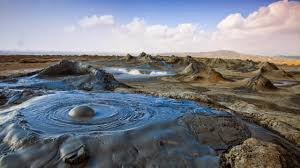
| Mud Volcanos in Gobustan, Azerbaijan |
Bond villains, war criminals, mud volcanoes and ununderstandable Scottish accents in this weeks Camino a Ítaca. It's the second year in a row that the United Conference Conference Climate Change conference (COP29) has been held in a fossil fuel dependant state and the watered down results are sadly foreseeable. We think we have so much choice, but do we? Click over to read the originally published piece in Spanish in the HOY or read the English translation below. This was also picked up in SUR in English. (PDF en castellano abajo)
The freshly laid blacktop
rolled out from Baku across the dun Gobustan desert like a strip of electrical tape
vainly adhering to the surface of a sandbox. Its very newness was a political
statement against the antediluvian moonscape, complete with gurgling mud
volcanoes, that stretched out from the bus’s tinted windows. It was a Monday
morning and the highland Scots oil technicians sitting around me were regaling
each other about their weekends in a shared language I could barely understand.
We saw them before they
could even be heard. Tremendous dust storms raised up out of the desert as a
pair of Apache helicopters buzzed past followed by two bigger transport
helicopters. One of which landed in the middle of the highway ahead and
disgorged a squad of troops that blocked the road. The American Secretary of
Defense, Donald Rumsfeld, was visiting the gas terminal where we were headed,
and it was about to be inaugurated.
We weren’t going to work
today. Geopolitics had literally landed in our path out in the wastelands of
Azerbaijan.
It’s been 20 years since
that pipeline opened the flow of gas from the Caspian to its terminus in
Turkey. Then, that highway was the only new road to have been built, let alone
repaved, since the USSR had collapsed some 15 years prior. Now, after 20 years
of gas revenues, the petrocity on the finger-like peninsula sticking out into
the world’s largest inland sea looks like Dubai on the fringes of the Central
Asian steppe.
Its oil riches have also
served to help establish it as a regional powerhouse. Projecting it onto the
international stage by hosting large events like Eurovision, the Azerbaijan
Grand Prix and most recently the United Nations Climate Change Conference. The
second consecutive year the conference has been held in a fossil fuel dependent
state.
Azerbaijan’s autocratic
president Ilham Aliyev took over the reigns of the small ex-Soviet
nation more than 20 years ago from his father Heydar Aliyev. Himself a former
high ranking KGB officer who morphed into a Bond-style Central Asian strongman.
The type with shark tanks in their plush offices who enjoy boiling opposition
figures and journalists in vats of oil.
His son has tempered down some of those strongman excesses
but continues to maintain a tight grip on the country, prompting the OSCE to
state that the recent parliamentary elections “did not offer voters genuine
political alternatives and took place within a legal framework overly
restrictive of fundamental freedoms and the media…”
This week Aliyev told world leaders gathered for
COP29 that natural gas was a “gift from God” and that the country shouldn’t be
blamed for bringing it to market. He
went on to expose hypocritical Western governments who buy his gas and lecture
him about torching the planet, “Unfortunately double standards, a habit to
lecture other countries and political hypocrisy became kind of modus
operandi for some politicians, state-controlled NGOs and fake news
media in some Western countries.”
Friday, November 15, 2024
Debuting in SUR in English
I've been writing for the Spanish newspaper HOY for almost 15 years now, but my pieces have always been in, surprise surprise, Spanish. It took a tragedy in Valencia and a chance look at a tranlated piece by my colleague J.R Alonso de la Torre to put the pieces together. Today, I try out my andaluz accent and publish my first piece for SUR in English, a newspaper that covers Málaga and Andalucia.
I do like to get down to the coast whenever I can. This way, at least my words are getting a bit of sea air. Click over for the first piece.
-
This plaque on the church is about the only evidence you'll find of Battuta's visit in the town o...
-
Yesterday I walked up the hill leading to my polling station under a clear blue sky, a color I would later realize that had foreshadowed th...

.png)


.png)