About Me

My photo
Troy Nahumko is an award-winning author based in Caceres, Spain. His recent work focuses on travels around the Mediterranean, from Tangier to Istanbul. As a writer and photographer he has contributed to newspapers and media such as Lonely Planet, The Boston Review, The Globe and Mail, The Sydney Morning Herald, The Toronto Star, Counterpunch,The Irish World, The Straits Times, The Calgary Herald, Khaleej Times, DW-World, Rabble and El Pais. He also writes a bi-weekly op-ed column 'Camino a Ítaca' for the Spanish newspaper HOY. His book, Stories Left in Stone, Trails and Traces in Cáceres, Spain is published by the University of Alberta Press.As an ESL materials writer he has worked with publishers such as Macmillan and CUP.

Saturday, November 25, 2023

Foreshadowing

In this week's Camino a Ìtaca I use a word that I never thought I would in the newspaper. Click over to read the originally published piece in Spanish in the HOY or read the English translation below. (PDF en castellano abajo).

I often wonder just how many times Maria Guardiola plays that crucial time in her life over and over in her mind. That moment where overnight she went from being a small fringe figure on the national political scene to becoming headline national news for speaking, at least what we believed at the time, her mind.

Do those vigorously communicated words that supposedly demonstrated her values and what she believed in play on a continuous loop in her dreams. Or does she need to recur to the help of a pharmacist just to get a few hours of uninterrupted sleep? This after she was so unceremoniously forced to swallow her words and go against everything she had promised and accept the line mandated from Madrid? Did getting into bed with the new blue shirts make for difficult nights?

Does seeing those who deny gender violence every day in her government make her a bit queasy, like riding on a ship on a stormy sea? When she thinks of the word ‘dehumanize’ does she think of all of those who have recently been settled in the region from the Canaries and the vile rhetoric the ultra-right party has slandered against them?

What about all those cultural battles that she swore had been overcome? Do they come to haunt her like Dicken’s ghost of Christmas past every time her partners open their mouths? Does she cringe on each occasion that her coalition partners give a press conference, worrying just how many of her damning words they make come true?

Then there are the rights that women have fought long and hard for that she once claimed were inalienable, like the right to abortion. Did she really mean what she said about red lines or are they too going to be placed on the table when she needs the fascists’ support?

A recent event in Caceres might shed some light on what could happen in the future. It all took place when the ultra-right party led by Eduardo Gutiérrez managed to push through a motion with an obvious ideological bias against abortion in a plenary session. As the mayor Rafa Mateos needs the green party’s support so that they will vote in favor of the 2024 budget, the PP chose not to abstain, but to actually vote in favor of a measure that looked as if it had been plucked from anti-abortionist publicity moldering in the entranceways to churches.

In the motion it called for “support for life through specific information provided by experts in the field, promoting a specific area of dissemination on the reality of abortion and its after-effects, with lectures and talks in high schools and focused on adolescents.”

Which begs the question if those who fervently believe that you’ll anger an all-powerful sky god by placing a latex sheath over a penis or that a Bedouin girl was miraculously impregnated by a pigeon so many years ago could actually be considered experts in the area of reproductive health.

 Thankfully the townhall has little if any control over education but this intrusion of such caveman-like ideology foreshadows what could happen at the regional level. Que Darwin nos coja confesados (Darwin have mercy!).


Saturday, November 11, 2023

Already?

'Tis the season on the Camino a Ìtaca or at least the streets are starting to look like it and it comes earlier every year. Click over on the Christmas lights to read the original piece in Spanish published in el HOY or read the English translation below. (PDF en castellano abajo)

Once upon a time in the not-so-distant past it didn’t begin until after the megapuente in December. Then as Amazon insidiously wormed its way into all our homes, it started to appear with Black Friday. Which is in effect the secular harvest celebration of Thanksgiving in America, now converted into a global orgiastic carnival of consumerism.

But that wasn’t enough. Now it has moved up the calendar and appears after Halloween, the tuned-up Dia de Todos los Santos celebration that the ofendiditos so love to hate. Look up and you’ll see them strung between lampposts, the harbinger of the longest season here in Spain, Christmas lights.

Ah, Christmas lights. Those twinkling, gaudy, and garish displays that punctuate our long, dark winter nights, like the flashing neon signs of the seedy roadside houses of ill repute that line the motorways across the country. These ostentatious displays of luminosity, meant to invoke a sense of wonder and joy, have become a hallmark of the holiday season.

However, when one examines the origins of these illuminations, it becomes clear that their early iterations were more about extravagance and opulence than any genuine spirit of Christmas.

In the late 19th century, as the world was undergoing rapid industrialization, inventors and entrepreneurs saw an opportunity to harness the power of electricity for commercial gain. It is here that the story of Christmas lights begins, not in a manger, but in the drawing rooms of capitalists.

One must acknowledge the genius of those early pioneers like Thomas Edison and Edward Johnson, who, in the 1880s, strung the first known electric lights as decorations for the holiday season. Edison's display at his Menlo Park laboratory was indeed a spectacle to behold, with its 80 red, white, and blue bulbs, illuminating a giant Christmas tree. Yet, while these technological marvels were undoubtedly impressive, their humble origins soon took a back seat to the commercialization of Christmas.

The embrace of electric lights as a holiday tradition was not merely a symbol of ingenuity but also a reflection of a burgeoning consumer culture. The more lights one could afford, the more opulent their display would be. The Christmas lights of today resemble more of a carnival than a solemn commemoration of a religious holiday. It’s now a spectacle, a distraction, and a testament to the power of consumerism.

We now see an arms race of sorts, as cities around the country compete to outshine one another with the most extravagant light displays. The extravagance of Vigo for example makes the headlines every year.

The idea of modesty and the true spirit of Christmas seems to fade into the shadows, replaced by the glamour and grandiosity of electric light. Christmas has become not a time for reflection, charity, and goodwill but a time for excess, conspicuous consumption, and one-upmanship.

The early pioneers of Christmas lights may have marveled at the magic of electric illumination, but it is important to consider the trajectory of this tradition. What started as a testament to human ingenuity and a nod to the festive spirit of Christmas has, over time, morphed into a glaring testament to our excesses and our obsession with appearances and, of course, shopping.


Sunday, October 29, 2023

Not again?

In this week's Camino a Ítaca, the space-time continum is once again altered. The cruel act happens this weekend in Europe and I believe the next in North America. Click over to read the original version published in Spanish in el HOY or read the English translation below. (PDF en castellano abajo)

It’s that time of year again for that biannual exercise in futility that was supposed to end for good sometime last millennium. A time where we prove to ourselves that we can tamper with the very fabric of time itself and still manage to be late for work on Monday morning. It's a global tradition as old as Benjamin Franklin's bifocals and twice as bewildering. It's as if someone took a perfectly functional clock and decided to add a level of complexity that would make a combined team of NASA engineers blush.

One can't help but wonder if Daylight Saving Time is some sort of grand social experiment, designed to test the limits of human adaptability. It's a cruel joke, like giving a blindfolded man a Rubik's Cube and asking him to solve it while riding a unicycle on a tightrope. It's a test of our ability to reset all our appliances in our cars and homes, avoid being late for appointments, and resist the urge to strangle the next person who cheerfully reminds us that we "lost an hour of sleep."

I can't help but picture the ancient Romans, with their sundials and toga-clad timekeepers, looking down at us and laughing. They managed to build an empire without ever resetting their sundials. Yet we, with all our technological advances and wizardry, are confounded twice a year by the simple act of moving a few hands on a clock.

And let's not forget the impact on our sleep patterns. It's as if we're all subjected to a cosmic jet lag, except without the sheer joy of international travel. Our circadian rhythms are thrown into disarray, and it's as if our brains are trying to decipher an alien language, one where "7:00 AM" suddenly means "6:00 AM" and "time for bed" means "I'll just watch one more episode on Netflix." It’s like constantly crossing back and forth over the border into Portugal without any signs or GPS telling you where you are and trying to arrive on time for a lunch date.

But perhaps the most absurd aspect of Daylight Saving Time is the way it creates a rift in the space-time continuum of our homes. You see, not all clocks reset themselves automatically through WIFI, and so we must embark on a scavenger hunt through our own homes, searching for those rebellious timepieces that insist on holding onto the old time. The microwave blinks 12:00 in defiance, while the wall clock chimes the hour with an air of superiority. It's a battle of wills between man and machine, and the machines are winning.

Daylight Saving Time is a biannual exercise in chaos, confusion, and cosmic comedy. It's a reminder that no matter how advanced our society becomes, we can still be bamboozled by the simplest of temporal manipulations. It’s an indicator that we really can’t make up our minds about something so simple as to leave the clocks alone.

So, when you find yourself bleary-eyed and befuddled on the morning after the time change, remember that you are not alone in your struggle. It's a spectacle that would have made the gods of Mount Olympus chuckle with amusement, while us mortals, drenched in coffee and confusion, continue to struggle through this timeless farce.Top of Form


Saturday, October 14, 2023

The End of an Era


In this week's Camino a Ítaca a look at how blind the far right is to the meaning of their own words. Click over to read the original piece published in el HOY or read the English translation below. (PDF en castellano abajo)

I never thought I would see something like this happen. It seemed to go against everything the National Catholic party had ever demonstrated since its formation. It’s a move so contradictory to everything they had previously stood for, and so diametrically opposed to their normally clear and outright bias in favor of the Catholic Church, that it almost makes you wonder if it was a mistake.

In their coalition agreement with the PP, they even went out of their way to make it a point to favor the concertados over public schools which in their vast majority are run by the Church.

So imagine my surprise when I saw that the extreme right party, in coalition with the PP in Extremadura, were going beyond anything that the left would ever dare try. But against all this, the neo-fascist parliamentary group registered in the Assembly of Extremadura a proposal to encourage the government of Maria Guardiola to remove religion from schools.

I was completely taken aback when I read it. In the text they urged “the necessary measures to promote the immediate withdrawal of textbooks and educational material containing any type of indoctrination or potentially harmful content that may affect the innocence of minors.”.

The audacious move would mean an end to the long-standing, state sponsored torture that has been meted out in both public and private schools across the region since public schooling began.

No more textbooks indoctrinating children that the Christian god is the one and only true god. No more books terrorizing children with the idea that they or their loved ones would spend an eternity burning in molten sulfur for going against the bronze-aged precepts laid out in the bible. No more nightmares for the ‘sin’ of going to McDonald’s and eating a hamburger on Fridays. No more sleepless nights worrying that their classmates who don’t go to religion will suffer in a purgatory far worse than the clase de la nada they now have to endure as an empty, time wasting alternative to religion class.

The vague, blanket statements that the extreme right specializes in to provoke emotive reactions also cause confusion. They purposefully make it difficult to discern what they are really trying to say behind their negative slogans. Making it difficult to establish what they really mean with their inflammatory yet empty statements.

Rather than clarify what they are for, what the extreme right always does is to go on about what they are against. They vociferously claim to be against any type of ideology in class, but rarely, if ever do they specify what they support and what they propose in exchange.

The Spanish curriculum is centered on equality, inclusiveness, solidarity, integration, tolerance, no discrimination and democracy. If this is what they are against, it’s clear that their ideology goes radically against core constitutional values.

So, what do they stand for? The opposite perhaps?

Inequality, both economically and socially? Exclusiveness? Good Catholics and gente de bien on one side and ghettos with armbands for the rest? Apartness and intolerance for newcomers who have just arrived?

Their empty slogans remain extremely dangerous, but at least this time it may bring about something positive.

Saturday, September 30, 2023

A City Besieged


In this week's Camino a Ítaca a look back at the summit of Culture Ministers from the EU that was held here in Caceres this week. Click over to read the original version published in Spanish in El HOY or read the English version below. (PDF en castellano abajo)

The scene in the square looked like some sort of Mad Max inspired gladiator theme in the gauzy early morning light. The sun had yet to come up over the Bujaco Tower and was just turning the crenellations of the Yerba and Hornos Towers a warm ochre.

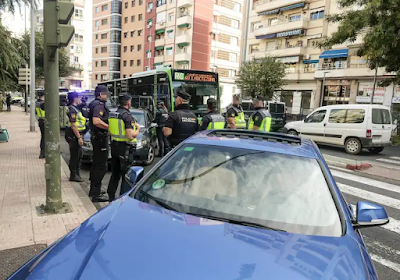
There, at opposite ends of the square, two riot vehicles from the National Police were facing off against each other across the barren quadrangle. Like some sort of dystopian jousting match, they sat immobile, ready to pounce at any time.

This wasn’t your everyday morning.

As we climbed the Gran Via, more blue vans rolled somewhat menacingly down the hill and into the square, looking like a procession right out of the authoritarian Handmaid’s Tale. In San Juan we came across a different kind of control. Two canine police dog contingents were parked next to the church and were getting ready to patrol.

Further up the street in Canovas we came across uniformed officers standing on street corners, some armed with heavy looking machine guns.

“Don’t stare at them like that!” warned my 10-year-old daughter as I was visibly taken aback by how heavily armed they were. “If you look at them too long, they’ll think that you want to rob a bank or something.”

But I wasn’t necessarily afraid. I had had enough experience with Spanish police to know that they are some of the most professional and relatively soft-handed police forces in the world, especially when compared with the brutal and barbaric policing in my native North America. Their overwhelming presence, however, on our daily walk to school was definitely domineering and even imperious.

And just as she finished her warning a police helicopter buzzed overhead as it repeatedly circled the city all day while seven more riot vehicles pulled around the Fuente luminosa.

Caceres was definitely under siege. The irony was why.

The culture ministers from all the countries in the EU were in town to talk about culture and here we were almost locked down. They had come to discuss the benefits that culture can bring about in society under a net of suspicion and protection so severe that it seemed like something out of Margret Atwood’s terrifying tale.

They had come to sign what will be known as the Caceres declaration. A document stating that the EU is committed to working to make culture a crucial element of policies in favor of peaceful, just and egalitarian societies. Because, they claim, culture plays an essential role in the construction of democratic societies and in the personal development of citizens and is a cornerstone of the European project.

But what kind of declaration will they be signing along with far-right governments from countries like Poland, Italy, Hungary, Sweden and Finland? Governments who are comfortable banning works of art that they don’t agree with and that are two steps away from holding public book burnings. Will Maria Guardiola find common cause with them and find support for her PP and its extreme right cohorts censoring works of art?

But then I look around at all the police presence and think, maybe they did this to make them feel at home?


Sunday, September 17, 2023

Belief is not Enough

In this week's Camino a Ítaca I take a look at how extreme religious belief can warp the way believers perceive events like climate change. Click over to read the originally published piece in Spanish in el HOY or read the English translation below. (PDF en castellano abajo)

We’ve been spared. The summer of horrors from around the world left us relatively unscathed. June to August was the planet’s warmest such period since records began in 1940, according to data from the European Union’s Copernicus Climate Change Service. And not just by a little bit. Here in Extremadura we may have had a few intense heat waves, but nothing in comparison with what other places have suffered around the globe.

From the biblically apocalyptic wildfires that brought smoke to the skies of Spain frommy homeland across the Atlantic in Canada, to those that ravaged Greece and Turkey, it’s been a summer of climate terror elsewhere.

Not that we have totally been spared. The early summer fire in las Hurdes could have just been a harbinger of things to come if it hadn’t been for that brief period of rain in June. Then the terrible fire in Tenerife acted as just another reminder what could happen here.

And then there are the typhoons, hurricanes and flooding. Hong Kong suffered its worst rains since records began 140 years ago, while places like South Korea, India and Sudan were hit by record flooding. Closer to home, a late summer DANA led to not only destruction but also death in Madrid.

But if those storms looked terrible, to add insult to injury after the deadly fires in Greece, a cataclysmic cyclone saw more than half a metre of rain fall on the country in less than 24 hours, also causing death and destruction.

Reactions vary to all these ominous portents, but there are still some who are in complete denial. Like the new consejera de Vox en la Junta de Extremadura, al frente de Gestión forestal y Mundo Rural, Camino Limia who tried to make a joke in response to a tweet warning about the forthcoming DANA in Madrid.

“Iremos preparando 'el arca' de Noe, puesto que las Arcas ya sabemos quiénes las están llenando con estos vaticinios apocalípticos.”

(rough translation: We need prepare Noah's ark, because we know who is filling their 'arks' (coffers) with such apocalyptic forecasts.)

It sounds like something someone might say after one too many gin and tonics, but this wasn’t at the bar. This was a consejera speaking publicly, making light of horrendous climate events that ended in several fatalities.

And while exceedingly unfortunate, her comment offers a revealing insight into the way she and her coreligionists perceive the world. The neofascist party that Maria Guardiola welcomed into government, after repeatedly swearing she wouldn’t, has never hidden its National Catholicism roots.

A ‘belief’ that leads its more extreme devotees to believe that things like climate change are a hoax spread by the illuminati because it would go against their ideal of a benevolent deity with a preordained plan for a world where man is welcome to subdue the earth and have dominion over every living thing.

Beliefs like this are as frightening as the climate emergency because they give the ardent believer an excuse to stop thinking. To stop questioning because their religious belief states that all is decided as a matter of faith. And religious faith can give people a sort of hyperbolic confidence. A dangerous action which paralyzes their critical thinking and leads them to obviate fact…especially in a public official.


Saturday, September 2, 2023

A Farewell to Summer


After a brief summer hiatus, the Camino a Ítaca is back with a goodbye. Today there are storm warnings and the temperatures have dropped. Click over to the adíos in El HOY or read the English translation below. (PDF en castellano abajo)

It was starting to get late. The waitresses had begun stacking up the tables that were left empty and were hovering closer and closer to those that were still occupied. Their attentiveness wasn’t necessarily focused on taking new orders, but more centered on somehow telegraphing their will so that their customers would settle up their bills, signaling that their evening could finally begin.

But it was a Friday night...and it was summer.

A woman was singing with a guitar player, accompanied by someone on the cajon. Their repertoire ranged from Amy Winehouse’s Back to Black to No Puedo Vivir Sin Ti by Coque Malla and occasionally one of their songs would strike up a singalong that would float from table to table. No one seemed to be in the rush that the waitresses were hoping for. Last call in the summer is at 2.30 and it was still a ways off.

The Plaza de la Concepcion, or La Conce as it is known, is a microcosm of Caceres. It’s near enough the old town to feel its weight and presence, yet far enough off the tourist trail to be 98% local.

It draws on people from all over the city. There are locals who live nearby and others finishing their strolls through the old town who know that having a drink on the Main Square means paying more money than it’s worth. The broad clientele runs from those who feel it’s a place to let their dogs roam free under the tables to smarter set funcionarios and families whose children play in the minuscule park adjacent to the larger terraces.

A roar of one of the motorcycles that also use the square tore through the air when suddenly I was hit by something on the chest. I looked down to see if I had been ‘luckily’ chosen as a target by one of the birds in the palm trees above but couldn’t see anything. The sky above the tower of the Palacio de Galarza was sallow and indistinct, marred by the haphazard lighting that kills the night skies above the city.

Then, I was hit by another…and yet one more. I looked around and saw others with equally surprised looks on their faces. They too were being hit.

A silence took over the square and then something that could only happen here in Spain took place… Everyone started to clap. It was August and it was raining. The mirage didn’t last long however, not even long enough for the drops to pattern the ground, but it was a sign. The long hot summer was coming to a finale.

There are those who can’t wait for the sweltering summers to end, for an end to short sleeves, flip flops, sweaty brows, gazpacho, and torrid nights.

I’m not one of them.

September means a return to shorter days, early mornings, flavorless tomatoes, traffic jams at 9am and a return to routine. In short, a return to school.

The end of summer brings with it a sense of loss and a sense of grief. Even if the warmth continues till October, its essence is gone. Pero que nos quita el bailao (literally, let them take away what we have already danced) it was great while it was here.


Saturday, July 8, 2023

Red Sky in the Morning...?


We recently had a Canadian visitor here in Spain, but this one wasn't welcome. Smoke from the huge wildfires there had drifted across the Atlantic and changed the color of our sky. This week's Camino a Ítaca looks at recent developments in Extremadura where the far right will enter into a coalition with the PP and the implications of this for the future of the climate. 

The apocalyptic ashen sun hung over the Torre de la Yerba like the cold, dead eye of a fish on ice. Its orangish red contour bled its inky light across the tapia Almohad tower, transforming the XII century military defensive structure into a warm crumbly ochre ice cream cone.

I had been showing my friend from Brooklyn, New York around the old city of Caceres during the sweltering heat of the summer’s first heatwave when she commented, “This sky is familiar. It looks just like it did in New York a few weeks ago with the smoke from the immense fires up in your homeland.”

I looked up into the haze and hazarded, “That’s sand from the Sahara. Here they call it ‘calima’. It blows up from the desert when there are big storms down there. It’s becoming more frequent and a few years ago it was so bad that the sky was literally orange for days and when it finally rained, it came down like muddy blood.” I was so sure that I was right that the conversation ended there and we continued our tour of the forest of renaissance palaces.

It wasn’t until the following morning that I found out she was right. This climate emergency wasn’t from across the Mediterranean. I read in this very newspaper that the pale discolored skies across the region weren’t due to Saharan sand at all, but from smoke that had drifted all the way across the Atlantic from the massive wildfires burning across the country of my birth, Canada.

The effects from a climate disaster half a world away were as tangible and easy to see as the sky above us. For some of us that is.

Now we have outspoken climate change deniers presiding over ministries in government here in Extremadura.

Maria Guardiola’s word lasted about as long as a snowfall in Badajoz. The soon-to-be President of the region who swore she wouldn’t give away ministries to the ultraright and who said her promise and her land were not bargaining chips for anything now finds that her word, her principles and supposed convictions are more ephemeral than snowflakes.

The woman who now says that her word is not as important as the future of the people of Extremadura has given over control of things like forest fires to a party that denies climate change and who attributes catastrophes like these wildfires to ‘climate fanaticism’.

With just 8% of the votes, many of which were given over in protest rather than rancid ideology, those who see bicycle lanes as a primordial threat to the essence of society are now in control of policies that protect and regulate the countryside. An area they claim has been abandoned by what they dismissively deride as frivolous green policies that come from the European Union and Agenda 2030.

The incoming President has clearly demonstrated that her word is as trustworthy as a drunken meteorologist performing a rain dance in July, but she is right about one thing, the future. While these religious zealots may embrace the vision of their benevolent Christian deity saving them from the flames of the coming climate collapse, what about the rest of us?


Saturday, June 24, 2023

Ideology? Mine's not Ideology!?


School's out on the Camino a Ítaca this week. Today a look at what education might look like if the PP forms a coalition government with the neofrancoists here in Extremadura and then at the national level. Click over to read the original in Spanish published in el HOY or read the English version below. (PDF en castellano abajo)

Each time I hoisted the eight or nine kilo bundle onto my shoulder, I was sure that it was going to be the last. The backpack’s left strap had begun to frazzle and fray under the tremendous weight sometime around Christmas and I was certain it wasn’t going to last the school year.

The senseless back and forth of its overflowing cargo of coursebooks acted as a daily, sweaty reminder of a broken school system overburdened with its excessive content, handicapped by its rigid inflexibility and reigned over by unaccountable civil servants with more job security than monarchs.  

The promised revolution of competence-based teaching that was supposed to be introduced with the latest education law had remained, like so many unimplemented innovations before it, forgotten, lost under those weighty tomes among the torn bits of paper and pencil shavings at the bottom of that pack. The law may have changed, but old habits hadn’t. (De)memorization, la copia, fill in the gaps and endless page turning still make up the bulk of classroom time in the mad rush to cover the seemingly endless contents.

And before this new law, the eighth since Spain’s return to democracy, has even had a chance to be thoroughly ignored and disregarded, distressing signs are pointing towards a possible change in government. One that could result in a coalition with the extreme right that would presage yet another reform.  

And that could be nightmarish.

The PP no longer holds a monopoly on the right and needs support to govern. Disaffected ultras from within its ranks have now migrated towards a much more extreme, aggressive brand of conservatism. One that bristles at the mere mention of pillars of modern education like inclusivity, plurality, diversity, sustainability and critical thinking. And it’s a party that desires power.

It’s a neofrancosim that unabashedly harkens back with fondness to the black and white days when education was solely controlled by the Church with stern nuns posing as teachers dishing out equal measures of liturgy and cruel punishment.

Under the euphemistic slogan of freedom of education and freedom of choice, this party wants to devolve even more power back to the Church that holds the vast majority of concertados in the country. All the while contradictorily insisting that ideology be removed from the classroom.

Another of their mottos is freedom of memory. A fallacious concept which would repeal the historical memory law, paving the way to them twisting history and begin presenting far right dictators like Hitler, Mussolini and Franco simply as misunderstood good Samaritans.

Our education system is seriously flawed and is in need of renovation. But the answer does not lie in going back to the days when it was taught that women came from men’s ribs or that the world was created in six days. What is needed is a profound overhaul in the way teachers are trained, chosen and then managed, along with a shift away from the excessive focus on content.

Contemporary methodologies present in the current law, where competences and learning to do are emphasized, work. They simply need a chance to be properly implemented, giving some much needed relief to those strained and worn out backpack straps.


Saturday, June 10, 2023

The Bear is at the Door


In this week's Camino a Ítaca a look at the new policial map here in Extremadura and the negotiations that are taking place between the parties on the right. Click over to read the original piece published in Spanish in el HOY or read the English translation below. (PDF en castellano abajo)

It was one of those urban myths that was so entirely bizarre that it was difficult to know if there was actually a grain of truth to it or not.

Legend once had it that incognizant American families would travel up to the Canadian national parks, cover their children’s hands with honey, and then send them to get close to wild grizzly bears so that they could get a picture with them.

Needless to say, the story never ended well.

The false Winnie the Pooh image they had of these wild animals was so completely at odds with reality that, in their ignorance, they heedlessly risked their children’s safety just to capture a photo. After all, it was just a teddy bear, wasn’t it?

And therein lies the danger. Real bears bite.

The political map of Extremadura has been redrawn and real live bears are now on the prowl. A new party with five key seats will be represented in the regional assembly in the upcoming session. Seats that will be decisive when choosing who will be the next President of Extremadura.

One of the biggest questions since this new party’s irruption on to the political scene nationally, and now in Extremadura, is how to precisely categorize this green ursus horribilis. Their abstruse nebulosity is only thickened by the fact that they didn’t even bother to prepare an electoral program specific for Extremadura.

This oversight was excused by claiming that they are a party with a national vocation. The naivety of which, presuming that the challenges faced here in Extremadura are the same as those in the Basque country, surmounts the ingenuousness of those poor children with honey on their hands. That is if it hadn’t in fact been done deliberately to obfuscate their true intentions.

In a cautious act of self-censorship, in just one newspaper you can see this newcomer labelled as extreme right, ultraright, radical right, ultranationalist, Trumpist, francoist and neofrancoist. But are these euphemisms and trivializations just a distraction from what the party really represents? If it looks like a duck, walks like a duck and quack like a duck, well...

The Partido Popular is also going to have to reexamine how they classify this excision to its right. For years it maintained these ultras within its ranks isolated and quiet, but they are now out in the open. After swearing she would never govern with them, the president of the PP in Extremadura, Maria Guardiola has now stated that its program coincides 90% with what the newcomers’ voters want.

The incoming mayor of Caceres, Rafa Mateos from the PP has gone even further in normalizing this party that won 2 seats in the city. In his view, parties themselves are not dangerous, only people are and that the spokesman of Vox had given him a very good feeling as a moderate person.

But this bear is no longer your drunk cuñado singing ‘Cara al Sol’, slurring that under Franco we lived better after a long afternoon with a bottle of Veterano, but a party at the gates of power. One that could have a say in such vital areas as education.

Let’s hope they leave the bears to their caverns.


Saturday, May 27, 2023

Placebo


This week's Camino a Ítaca falls on Election Silence day, the blackout period when parties can no longer campaign before tomorrow's elections here in Spain. Autonomous communities and towns are up for grabs on Sunday and a particular sign on the street caused me to think. Click over to read the original version published in el HOY in Spanish or read the English version below. (PDF en castellano abajo)

The sign on the street said it with more barefaced, outright clarity than I had yet seen. There was no forced smiling face, no innovative ideas and not even the slightest attempt was made to masquerade behind any semblance of thought or individuality. It was as blatant as could be.

Vote for party X.

There on a street corner, the blighted, corrupt nature of Spanish politics was on full display, replete in a blue bus stop sign.

There wasn’t an idea in sight, nor any indication that there ever would be. It was the visual equivalent of a sugar pill placebo, with no active properties, being administered to the infirm. Take this and don’t question what ‘this’ is. It doesn’t matter. Just believe in our brand, take it and everything will somehow be alright.

There on that billboard was a question of faith rather than of democratic inquiry. It was the power and dominion of political parties in this country on full display and a shining example of the sheer brutality of their hegemony obviating independence of thought.

The streets have been colorful for the past two weeks with the primary colors of the national political parties flashing from lampposts. The political equivalents of Nike, Netflix or Apple flapping in the breeze, pleading to their faithful users to continue confiding in their collective, extraterritorial ineptitude.

Because when you cast a vote for the closed lists of these national giants, you automatically delegate decisions to Madrid. The parties’ regional representatives can claim to be independent regionalists and can even go so far as to purport to be progressive. Like the blue candidate who has stated in the press that she supposedly draws the line at the gains made by women and LGBTQ2+ collectives and supports their cause.

But the reality remains that the national party she represents reeks overwhelmingly like a burning bush. One that consistently takes any measure that contravenes atavistic laws dictated by a vengeful skygod that were written on stone tablets by bronze-aged Israelite stenographers to the Supreme Court. Even if she doesn’t base her values on pre-germ theory criteria, any contradiction of these primeval norms will always be overturned at the national level.

Then there is the prepollent party that has been in power in Extremadura for more than three decades. A party that, in more than a generation, has been unable to convincingly convey to Madrid the utter and complete exasperation felt by the inhabitants who live in what is in effect a second-class region. A region unable to aspire to services that other communities take for granted.

While trains combust and funds that should be destined here get derived to other parts of the country that support the coalition, rather than protest daily in front of the Moncloa, not even a strongly worded email is sent in dissent to the party leaders.

Today is a day to reflect, to think about the past, to ponder the future and examine where we foresee our cities and region developing. That paper tomorrow is a choice. One that can mean the ongoing outsourcing of decision making and the tired same old same old. Or it can mean a chance at something new.


Moving Shop

  We've moved house. This blog has moved to  https://troynahumko.com/ See you over there!